7 Days in Puglia which towns actually matter?
An honest, slow-travel route through Italy's heel
Most guides will send you on the same loop. Bari, Polignano, Alberobello, Ostuni — five towns, seven days, a checklist. The kind of itinerary that looks beautiful on a feed and leaves you exhausted by Day 4.
We'd rather tell you what's actually worth your time.
This is the route we'd send a friend. Ten places across seven days, with one base, short drives, and enough room to sit through a long lunch without watching the clock. Some towns are famous for a reason. Others are famous despite themselves. And a few of the best ones, almost no one talks about.
Save it. Read it again before you book. And ignore the parts that don't fit your trip.
A few things before you go
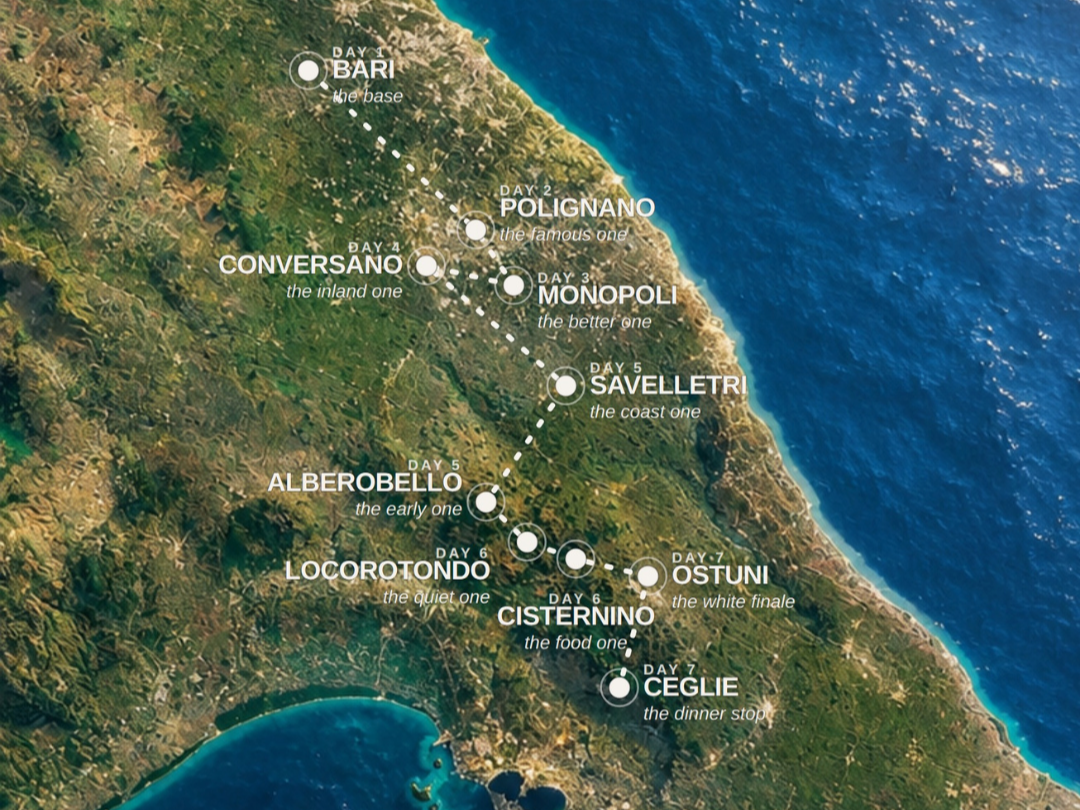
Puglia looks small on the map. It isn't. The tiny coastal roads, the trulli villages, the inland Valle d'Itria — they all add up. One town per day, maximum. That's the rule that makes the difference between a trip you remember and a week of driving.
The route
A few other things worth knowing:
Rent the smallest car you can. The old towns weren't built for SUVs. A Fiat Panda goes everywhere; an Audi Q5 won't fit through Ostuni's gate.
Avoid July and August. Hot, crowded, and no longer cheap. May, June, September and early October are the months we'd come back for.
The clock is different here. Shops close from 1 to 4 PM. Restaurants don't open before 8. Dinner ends at midnight. Nobody is in a rush. Adjust your day, not theirs.
Don't drive into the historic centers. Most are ZTL — restricted traffic zones. Cameras catch you, the fine arrives at your home weeks later. Park outside the walls. Walk in.
Day 1 — Bari, the base
Most travelers land here and leave within hours. That's the first mistake.
Bari isn't pretty in the classic Puglia way — it's a working port, loud, layered, alive. The old town (Bari Vecchia) is a maze of white walls, laundry lines, and pasta nonnas working at their front doors. The Murat district, just across the railway, has the best shopping in Puglia and a quiet natural wine scene no one writes about.
Stay two nights, minimum. One is just landing.
A full Bari deep-dive — where to go, eat, drink, shop and stay — is in our next post on Bari.
Day 2 — Polignano a Mare, the famous one
Yes, you've seen the photos. The cliffs, the turquoise cove, Lama Monachile beach packed with day-trippers from June onwards. It's beautiful. It's also extremely well-known.
Our tip: don't day-trip. Sleep there. When the buses leave at 5 PM, Polignano becomes itself again — empty white streets, fishermen mending nets, families on the piazza. Eat at one of the cliffside restaurants, but book ahead. And get up early for a swim at Cala Paura, the quieter local cove just south of the famous one.
Day 3 — Monopoli, the better one
If Polignano is the magazine cover, Monopoli is the magazine. Bigger old town, more layers, fewer Instagram crowds, and a working harbor where fishermen still sell their catch in the morning.
Walk the white-walled streets early, eat seafood at lunch, and find a spiaggia libera (free public beach) in the afternoon — there are several inside the old town walls. Monopoli rewards the slow day.
Day 4 — Conversano, the inland one
Almost no one tells you about Conversano. Twenty minutes inland from the coast, with a Norman castle, a Romanesque cathedral, and the kind of slow-life energy that's been quietly disappearing from the famous towns.
Spend the morning wandering, have a long lunch at one of the family-run trattorie, and finish at one of the inland masserie for an aperitivo with olive groves all around. This is the Puglia people remember years later.
Day 5 — Savelletri & Alberobello
A coast morning and a trulli afternoon.
Savelletri is a fishing village just below Fasano, with a small harbor, working boats, and some of the best seafood restaurants in the region. It's where the masseria-stay crowd comes for lunch when they want something less polished.
Alberobello, the trulli town, is on every Puglia route — and for good reason. The cone-roofed stone houses are extraordinary. But go early. By 11 AM the tour buses arrive and the magic dissolves. Be there by 8 AM, walk the Rione Monti, and leave before the day-trippers wake up.
Day 6 — Locorotondo & Cisternino
Two of the smallest, prettiest towns in the Valle d'Itria. And almost everyone underestimates them.
Locorotondo is a perfect white circle of a town, named for its round layout. Quieter than its neighbors, with a small but excellent wine scene — the local Bianco di Locorotondo is one of the most underrated whites in southern Italy.
Cisternino, fifteen minutes away, is famous for one thing: the fornelli pronti. Local butchers double as grill spots in the evening — you pick your meat, they cook it, you eat at a long communal table. Simple, loud, deeply Pugliese.
Day 7 — Ostuni & Ceglie Messapica
Ostuni — "the white city" — is the postcard. White-painted walls climbing a hill, narrow alleys spilling out onto sea views, a cathedral square that's been photographed a million times. It deserves the attention. Walk it slowly, find a rooftop, watch the light shift.
For dinner, drive twenty minutes inland to Ceglie Messapica. Smaller, less obvious, with a serious food culture — it's one of the unofficial gastronomic capitals of Puglia. End your trip at a trattoria where the menu still changes daily and the wine list is half-handwritten. That's the ending Puglia deserves.
What this route doesn't include
You'll notice we left some things out.
Lecce — the Baroque capital of the south — isn't on this route, and that's deliberate. Lecce deserves its own three days, not a rushed afternoon at the end of a coastal loop. The same goes for Otranto, Gallipoli, and the deep Salento. They're worth a separate trip.
The Gargano peninsula in the north — Vieste, the Tremiti islands, the Umbra forest — is another world entirely. Stunning, but completely different in feel.
This route stays in the Valle d'Itria and the central coast. It's the Puglia people fall in love with first.
A few final honest notes
You don't have to follow this exactly. Stay longer in places you love. Skip the ones that don't fit. The map is a suggestion.
The best moments aren't on the list. They happen between stops — at the small bakery you find by accident, the masseria pool nobody told you about, the village festival you stumble into.
Slow is the point. If you find yourself rushing to fit it all in, you're doing Puglia wrong.
The route in one image: see our route map — saveable and ready for your trip.
Have a favorite spot or a town we missed? Drop us a note in the comments, or tag us @pugliaedit on Instagram.